October 2026. A Notes from the Flock issue, for The Agent Shepherd.
The flock is not a stack diagram. It is whoever already worked before I sat down.
This is the first written picture, so October has to do two jobs at once. It is the baseline, and it is also the month the setup actually moved. I am writing it down because I could not say, cleanly, which agent had done what, and that is a bad way to run a month.
What changed this month
Eight moves. I am not going to invent a ninth so the month looks busier than it was.
The day no longer waits for me to open a laptop. GrokBot carries that day, and it is a crew of agents, not one. Aruna is one of them, and the job is AI CMO. Amazon Quick rose in the same stretch, and more of the business work goes there now, because it learns a company, keeps the professional context, and holds a knowledge graph. A question about a firm, a role, or a deal lands there more often than it used to.
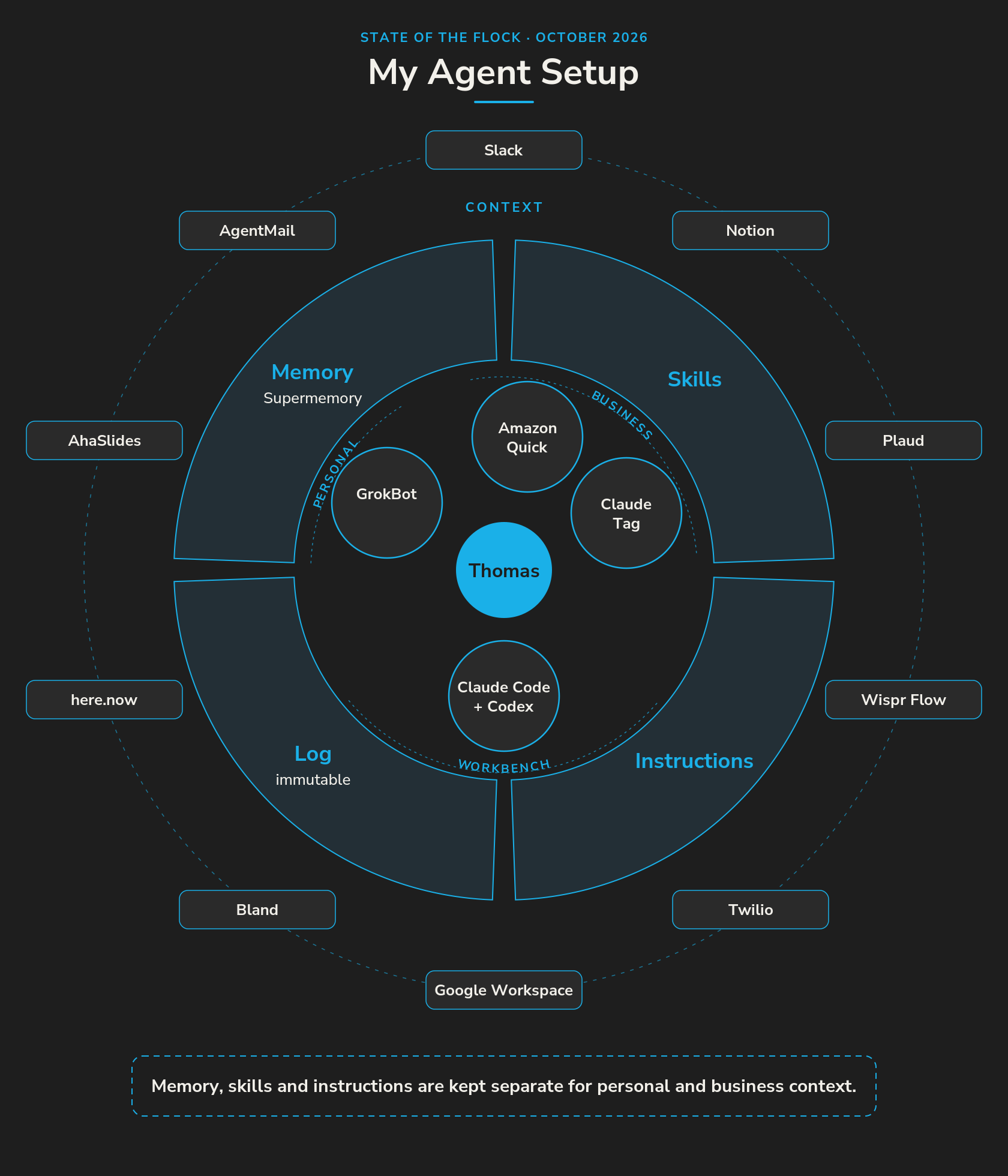
I committed to Supermemory as the memory the agents share. It does not belong to Claude, or to GrokBot, or to whichever window I happened to open. Claude also has memsearch, a notebook for each project folder. After every reply it writes a few lines on what was said, indexes them on my machine, and shows Claude the latest ones when I open the next session, so we pick up where we left off. It is short-term recall. The shared memory is Supermemory, and it is the only one now. Access is split by reach: Claude and Amazon Quick see only the 56k space, while GrokBot sees all of them, business and personal. Skills follow the same line. Claude and Amazon Quick get only the 56k company skills; GrokBot gets every skill, company and personal, from my skills repo.
The books are on GitHub Pro, and beside the code sits an append-only agent log. I am keeping the reason in the sentence I actually mean: so we can see who broke into the pantry and ate all the cookies. Append-only is the point, because an agent that can rewrite its own past is an agent I cannot audit.
My agents get secrets from 1Password and nowhere else, and every key is scoped as tightly as the service allows. Access needs my approval, and when 1Password is locked, the agents that depend on it simply wait.
The flock can ask Claude, and the door is a dedicated mailbox. That is how an agent gets a question into the place where the heavy collaborative work happens.
Key agents have their own mailbox on AgentMail, and Agent Armor screens inbound mail for prompt injection before that mail can become a prompt. A few of them:
- Hugo is my AI chief of staff, a plush hippo resurrected as an AI agent. He keeps the threads together across the flock.
- Coin manages the Agentic Commerce launch and book: the plan, the open items, the site and the dates. It also handles the weekly blog post, which goes live only after I say OK.
- My smaller ventures each have a dedicated agent of their own.
here.now is where my agents publish a page to a live link in seconds. It hosts the customer deal rooms on here.56k.cloud, each one open only to that customer, plus lab pages and one-off pages I need to share.
The ai-workforce repo is the org chart for the flock, and the manual for how it runs. When the question is who does what, the answer is in that repo.
The current picture
Those eight are the moves. The rest of the picture is what they sit inside.
Claude is still where most of the heavy collaborative work happens, and I am in the thread for that work. ChatGPT is still in the mix, a bit, and I have not measured the share, so I will not quote one.
Signal Factory still runs on Trigger.dev, on a clock: Wednesday is AI Governance, Friday is Agentic Commerce, Sunday is This Week in AI, and the 1st is This Month in AI. I am not recapping what those issues said. LinkedIn teasers for the series go out through Typefully.
Repo work goes to Cursor cloud agents, who do that work as a pull request and merge it right away. The diff is the record of what they touched.
The picture for this issue sits at the end of the post. I sit at the centre. Around me are the agents: Claude Tag and Amazon Quick for business, GrokBot as my personal always-on crew, and the workbench, Claude Code and Codex, which I use for everything. The thick ring around them is context, in four parts: memory in Supermemory, skills, instructions, and the immutable log. Memory, skills and instructions are kept separate for personal and business context. The tools sit on the outer ring, and none of them is special.
What each tool on the ring does
The ring is the set of tools the agents can reach. This is what each one actually does.
- Slack is the main shared workspace inside 56k, so the agents work in it there, alongside the team. It is also where signals come in.
- Notion holds the stable context and the notes. Some routines fetch their instructions from a Notion page and run them exactly as written, so the page is the source of truth, not the agent's memory.
- Plaud records meetings in the room and on the go. The agents pull the transcripts through the connector, and a transcript stays raw material until a decision is written somewhere an agent can find it later.
- Wispr Flow covers online calls and dictation. I dictate about 90% of my work, or type it, and Wispr Flow turns the voice into text.
- Twilio sends and receives WhatsApp and SMS for the agents.
- Google Workspace covers all of it. The agents manage my calendar, write in Docs, Slides and Sheets, and draft email that waits for my approval before it goes.
- Bland is a voice agent gateway. The agents call people and collect their answers. It is a simple voice agent, and it is still in test.
- here.now publishes a page to a live link in seconds. The deal rooms and lab pages above live there.
- AhaSlides runs live polls, quizzes and surveys in my seminars. It has a connector, so the agent and I build the poll by talking it through, with no separate app and no clicking.
- AgentMail gives agents real mailboxes with webhooks, so they can act the moment a mail lands.
About 90% of my emails and Slack messages are now written by an agent from my instruction. Every personal email is read by a human before it goes out. On AgentMail, agents can answer on their own, depending on the use case. I sign my emails with "Thomas" plus the AI that helped build it.
The finding
One finding this month matters more than any single tool: working with an agent is dramatically easier in Google Workspace than in Microsoft Office. I noticed it most with PowerPoint versus Google Slides, but it is the same for Excel versus Sheets and Word versus Docs.
In Office, the agent works on a copy. It produces a file, I open it, I fix it, and the next round starts from whichever version survived. Nobody is looking at the same thing at the same time.
In Google Slides, Docs and Sheets, the agent and I edit the same live document. I see its change the moment it lands, I correct it in place, and it picks up from my correction. When Claude released its plugin for Google Slides, that settled it. I switched mainly because of the joint collaboration surface, not because of a feature. My AI seminar deck moved from a PowerPoint template to Google Slides, where the agent built a slide straight into the deck I was working on.
The lesson
The more you trust agents, the clearer you must be about what they did.
I trust GrokBot with the day, a cloud agent with a pull request, and Hugo with a mailbox. That trust is real only when I can point at a log, a diff, or a draft and say which one, at what time, did the thing. A clever agent with no trace is a story I tell after the cookies are gone. The org chart says who was supposed to do the work, and the append-only log says who actually touched it.
What's next
The next State of the Flock comes in November, with a fresh picture of the setup.